
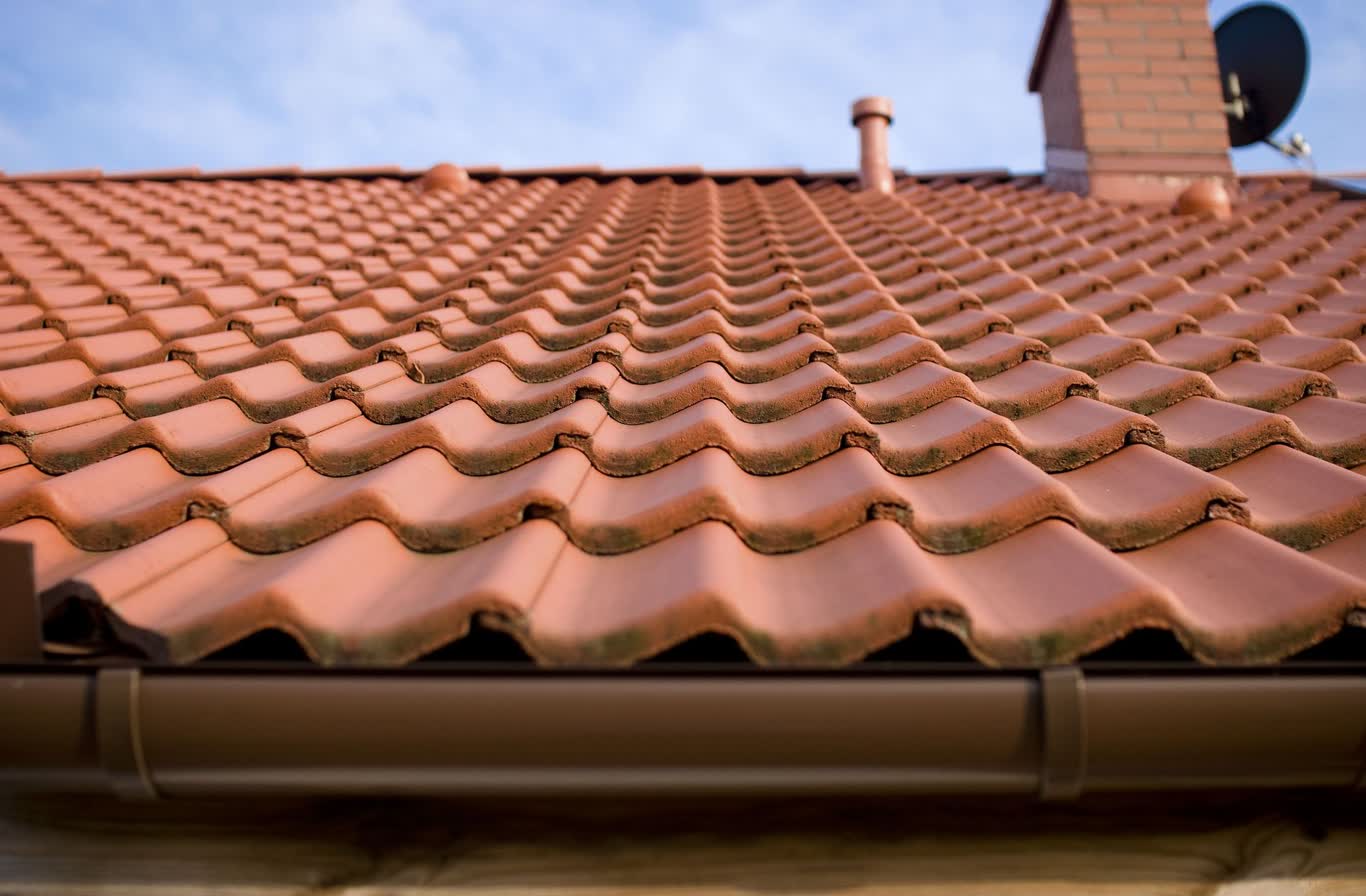
Why Does Tile Roof Underlayment Fail Before the Tile?
Concrete and clay tile are extremely durable. Dalton Roofing typically sees concrete tile last 40 to 50 years in Florida’s climate, and clay often longer. But tile is not a sealed surface. Wind-driven rain gets between and under the tiles by design, and the layer underneath — the underlayment — is what actually carries that water off the roof.
That underlayment lives in a punishing environment. Temperatures under a dark tile roof in a Port St. Lucie summer climb far above the air temperature. Years of heat cycling dry out and embrittle felt and older asphalt-based membranes, fasteners work loose, and seams open up. Debris collects in valleys and behind tiles, holding moisture against the underlayment. Eventually water that used to run off starts reaching the roof deck.
This is why we tell every tile-roof owner the same thing we say on our tile roofing page: on a re-roof, the underlayment gets replaced regardless of how good the tile looks.
How Long Does Tile Roof Underlayment Last in Florida?
It depends on what was installed. Older tile roofs on the Treasure Coast usually have felt-based systems; newer roofs are more likely to use synthetic or self-adhered membranes. General industry ranges — which run toward the shorter end in South Florida heat — look like this:
| Underlayment type | Typical service life in Florida | Notes |
|---|---|---|
| Organic felt (hot-mopped or mechanically attached) | About 15–20 years | Common on older tile roofs; becomes brittle with heat |
| Fiberglass-reinforced felt | About 20–25 years | More tear-resistant than organic felt |
| Synthetic underlayment | About 25–35 years | Lighter, stronger; used in many two-layer systems |
| Self-adhered modified-bitumen membrane | About 25–40 years | Seals around fasteners; also serves as a secondary water barrier |
Ranges are general market information, not a guarantee for any specific roof. Installation quality, roof pitch, ventilation, and how well valleys are kept clear all move the number.
What Are the Signs Your Tile Roof Underlayment Is Failing?
Because the tiles can look perfect from the driveway, underlayment problems are easy to miss until water shows up inside. Watch for:
- Leaks that appear only in heavy or wind-driven rain, especially during summer storms or tropical weather, while the tiles look intact.
- Ceiling or wall stains near exterior walls, valleys, or below roof penetrations like vents and skylights.
- Stained, dark, or soft roof decking seen from the attic, or daylight showing through the deck.
- Brittle black fragments or granules washing into gutters, valleys, or onto the ground below the eaves.
- Slipped, loose, or cracked tiles — which let more water reach an already aging underlayment.
- Musty attic odor or mold on the underside of the deck or on stored items.
- Age. A tile roof 20 or more years old that still has its original underlayment is due for a professional evaluation even without symptoms.
A roof inspection from inside the attic and on the roof can confirm what is happening. See what our free roof inspection covers.
Why Is This Hitting Port St. Lucie Tile Roofs Now?
Port St. Lucie and the surrounding Treasure Coast grew rapidly in the late 1990s and 2000s, and concrete tile was a popular choice on homes built in that era — in communities across St. Lucie West, Tradition, PGA Village, Palm City, and Stuart. A roof installed in 2002 or 2005 is now roughly two decades old. The tile on it may have many years left, but the original underlayment is at or past its typical service life.
At the same time, insurers are paying closer attention to roof age, and homes built before 2008 may qualify for the state’s hurricane mitigation grant. That combination makes now a good time for owners of 2000s-era tile roofs to find out where they stand — before a leak forces the decision during storm season.
Re-Lay vs. Full Tile Replacement: How Do You Decide?
Both options replace the underlayment, flashing, and any damaged decking, and both are full re-roofs under the building code. The difference is whether your existing tile goes back on.
| Factor | Tile re-lay (lift and reset) | Full tile replacement |
|---|---|---|
| What happens to the tile | Removed, stacked, and reinstalled; broken pieces replaced | Removed and replaced with new tile |
| Best when | Tile is sound, the profile is still available, and the deck is mostly healthy | Tile is widely cracked, delaminating, or discontinued; or you want a new look |
| Relative cost | Usually lower — you are not buying a full roof of new tile | Higher — new tile, delivery, and handling |
| Biggest variable | Tile breakage rate and finding matching replacements | Tile selection and deck repairs found at tear-off |
| Appearance afterward | Original look; replacement tiles may be slightly different in color at first | Uniform new appearance |
| Code and permit | Permitted re-roof; tile reattached to current code | Permitted re-roof; new system to current code |
Discontinued profiles are the hidden problem. Many tile shapes and colors used in the early 2000s are no longer made. If yours is one of them, replacement pieces have to come from salvage or from less-visible areas of your own roof. When matches cannot be found in enough quantity, a full replacement is often the more practical choice. For a broader look at the decision, see roof repair vs. replacement.
What Happens During a Tile Re-Lay?
- Permit and planning. The contractor pulls the re-roof permit and agrees on an assumed breakage percentage and tile sourcing plan with you in writing.
- Tile removal. Tiles are lifted by hand, inspected, and stacked on the roof or on the ground, sorted by condition.
- Tear-off. The old underlayment, battens (if any), and worn flashing are removed down to the deck.
- Deck repair and re-nailing. Damaged sheathing is replaced and the deck is fastened to current code. The building department inspects the deck attachment.
- New underlayment and water barrier. New underlayment is installed, typically as part of a system that also serves as the required secondary water barrier. New flashing goes in at walls, valleys, and penetrations. The dry-in is inspected.
- Tile reinstallation. Tiles are reattached using the fastening method required for your roof’s wind design — mechanical fasteners, approved foam adhesive, or a combination — with hips and ridges set properly.
- Final inspection and cleanup. The building department performs the final inspection. Afterward, order an updated wind mitigation report for your insurer.
What Drives the Cost of Replacing Tile Underlayment?
We don’t publish ballpark prices, because a tile roof’s cost depends heavily on details you can’t see from the ground. The main drivers are:
- Roof size and complexity — hips, valleys, and multiple levels add labor.
- Pitch and access — steep roofs and tight lots slow tile handling.
- Tile breakage — with sound concrete tile and a careful crew, breakage commonly runs around 5% to 15%; brittle, older, or clay tile can run higher.
- Replacement tile availability — discontinued profiles cost more per piece and take longer to source.
- Deck condition — rotted sheathing discovered at tear-off must be replaced.
- Underlayment system — a self-adhered membrane costs more than felt but lasts longer and doubles as a secondary water barrier.
- Code upgrades — deck re-nailing and, on some older homes, roof-to-wall connection upgrades.
Our guide to what drives a roof replacement’s cost in Florida goes deeper, and financing is available for qualified homeowners.
What Permits and Inspections Apply in St. Lucie County?
Replacing tile underlayment means removing the roof covering, so it is a re-roof, not a repair. In Port St. Lucie that permit goes through the City of Port St. Lucie Building Department; in unincorporated areas and Fort Pierce-area addresses outside city limits it goes through St. Lucie County (or the City of Fort Pierce inside city limits). In Stuart and Palm City, Martin County or the City of Stuart applies.
Across these jurisdictions, expect:
- Florida Product Approval (or Miami-Dade NOA) numbers for the tile, underlayment, and adhesives in the permit package.
- Tile attachment designed for your home’s wind requirements. The Florida Building Code references the FRSA-TRI Florida High Wind Concrete and Clay Roof Tile Installation Manual for tile installation. The Treasure Coast sits outside the High-Velocity Hurricane Zone but inside Florida’s wind-borne debris region.
- Inspections at key stages — typically deck attachment, dry-in (underlayment and secondary water barrier) before tile goes back on, and final.
- A recorded Notice of Commencement for larger jobs, and HOA architectural approval if you live in a deed-restricted community.
A licensed roofing contractor should handle the permit. For more, see roof permits and HOA approval in Florida.
How Does an Aging Tile Roof Affect Your Insurance?
Florida law gives homeowners some protection. Under Section 627.7011, Florida Statutes, an insurer may not refuse to issue or renew a policy solely because the roof is less than 15 years old. For roofs 15 or older, you have the right to an inspection by an authorized inspector, and if it shows at least five years of useful life remaining, the insurer may not refuse coverage solely because of roof age.
Insurers generally look at the date of the most recent permitted re-roof when judging roof age. A permitted re-lay replaces the entire waterproofing system under a new permit, so ask your carrier how it will treat the work before you start. Afterward, a new wind mitigation inspection can document the new secondary water barrier and deck attachment for premium credits.
If your home was permitted before 2008 and is homesteaded, the state’s hurricane mitigation grant may help pay for eligible parts of the work. See our My Safe Florida Home grant guide — and do not start work before a grant is approved.
This article is general information, not legal or insurance advice. Code requirements vary by jurisdiction and roof design; confirm details with your building department, insurer, and a licensed contractor.
Wondering whether your tile roof needs a re-lay, a replacement, or just a repair? Dalton Roofing will inspect it from the attic and the roof, tell you honestly which option fits, and put the breakage assumptions in writing. Schedule a free roof inspection or call (561) 662-6622. Se habla español.