
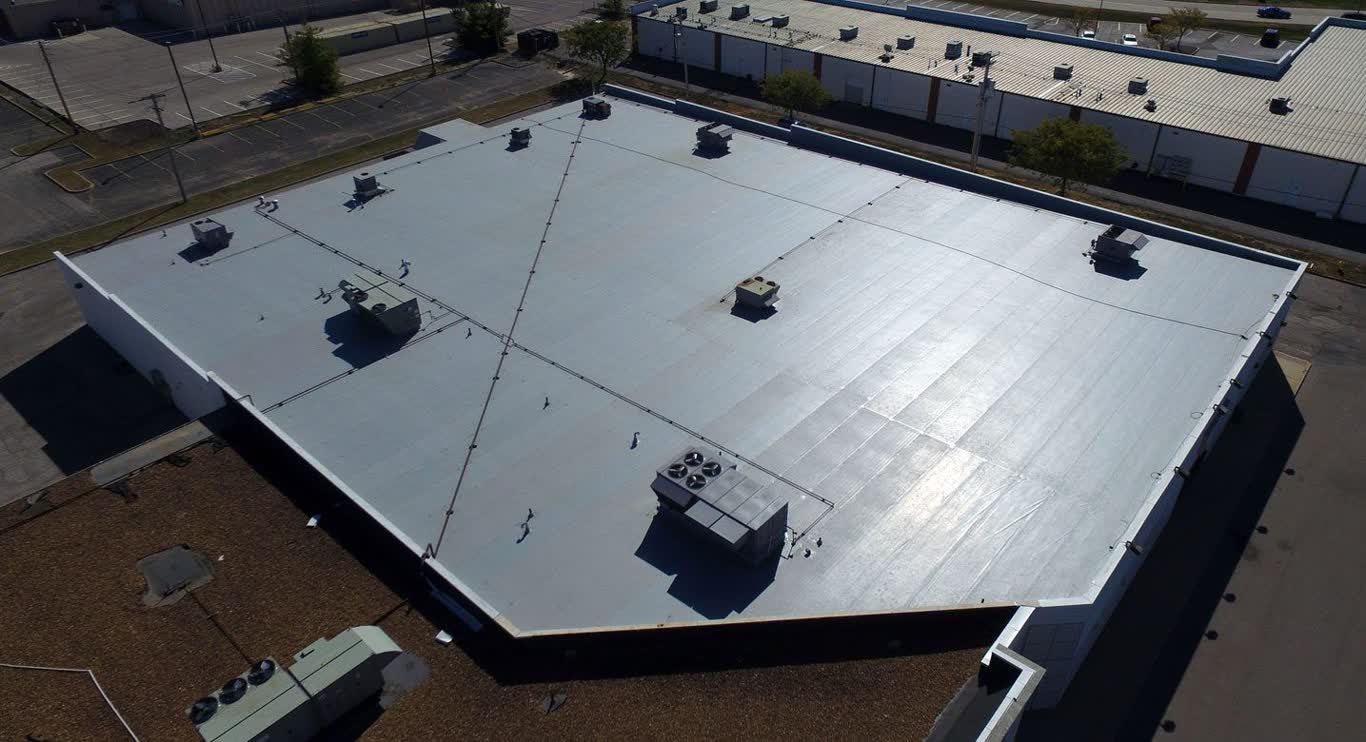
Property managers and building owners across St. Lucie, Martin, Palm Beach, and Indian River counties ask this question every time a commercial roof starts showing its age: how much time do we actually have left, and what changes that number? The lifespan of a commercial roof in Florida ranges from roughly 15 years for a neglected modified bitumen system to 60-plus years for a well-maintained metal roof, and maintenance — not just the material — decides where any given roof lands in that range.
What Is the Lifespan of a Commercial Roof, by System?
There is no single number, because “commercial roof” covers several different materials with different manufacturer warranty structures. What is comparable is the warranty range each manufacturer publishes and the general service-life data available for the system category.
Commercial Roof System Comparison
| Roof system | Manufacturer-backed warranty range | General service-life data | Best fit |
|---|---|---|---|
| TPO (thermoplastic polyolefin) membrane | 5–30 years depending on system tier and mil thickness (Source: Elevate) | Tracks the warranty term when annually inspected | Low-slope commercial and flat roofs wanting a reflective, heat-welded membrane |
| Modified bitumen (SBS/APP) | Terms vary by manufacturer and installation depth; ask your installer for the specific published warranty on the system quoted | Tracks the warranty term with regular seam and flashing maintenance | Low-slope roofs that need extra puncture and foot-traffic resistance |
| Standing-seam metal | Finish/paint warranties are typically decades long; the panel substrate is rated separately | 40–60+ years for coated-steel and Galvalume assemblies (Source: Metal Construction Association) | Buildings planning a long ownership horizon that can absorb a higher upfront cost |
| Silicone/elastomeric coating | Material warranties up to 20 years at specified mil thickness, often performing well beyond that term (Source: PM Silicone) | Restores and extends an existing roof rather than replacing it; recoat cycles are driven by wear, penetrations, and damage, not a fixed year count | Restoring an aging TPO, metal, or modified bitumen roof instead of a full tear-off |
A few things worth noting in that table. First, a coating is not a fifth competing roof system — it is a maintenance and restoration strategy applied on top of one of the other three. Second, every warranty figure above is a manufacturer number tied to a specific installation and inspection standard, not a guarantee that applies automatically to any roof of that type. Third, none of these ranges account for Florida's specific exposure: year-round UV load and, along the coast, salt air, are both reasons the low end of each range shows up more often here than in a drier, cooler climate.
How Long Does a Commercial Roof Last Without Regular Maintenance?
Shorter than the numbers above suggest. Two forces work against an unmaintained commercial roof at the same time.
The first is physical. Minor issues compound — a lifted seam, a clogged drain, a punctured flashing. A small leak that goes unnoticed for a season can saturate insulation, and wet insulation degrades a membrane's performance from underneath long before the membrane itself would otherwise fail.
The second is contractual. Many manufacturer warranties, including No Dollar Limit (NDL) coverage, are conditioned on documented maintenance. The exact terms vary by manufacturer, so always check your specific warranty document rather than assume a general rule. Miss a required inspection, and the roof can lose warranty protection even while the membrane is still structurally sound. That means the “lifespan” that matters most — the one your insurance and lender care about — can end earlier than the material's physical life would allow.
Why Does Your Commercial Roof Need Preventive Maintenance?
The National Roofing Contractors Association puts it plainly: roof system maintenance is “the single most important factor (after proper installation) for determining the life span and cost of a roof system” (Source: NRCA). That statement covers every system in the table above — TPO, modified bitumen, and metal all benefit from the same basic discipline.
Preventive maintenance for a commercial roof generally means:
- A documented annual inspection by a licensed contractor. Many manufacturer warranties condition coverage on inspections like this, but exact requirements vary by system, so check your specific warranty terms.
- Drain, scupper, and gutter clearing, since ponding water is one of the fastest ways to shorten a low-slope membrane's service life.
- Seam, flashing, and penetration checks around HVAC curbs, vents, and parapet walls, where movement and thermal cycling create the earliest failure points.
- Prompt minor repairs, so a small blister or lifted seam gets addressed before it becomes a deck-level leak.
- Post-storm walk-throughs after any named storm or severe thunderstorm cell tracks near the property, in addition to the required annual visit.
- Written, photo-documented records of every visit, which double as the paper trail an insurer or manufacturer will ask for after a claim.
How Often Should a Commercial Roof Be Inspected?
At minimum, once a year. An annual inspection is standard industry practice, and many manufacturer warranties condition coverage on documented inspections, so check your specific warranty terms to confirm the required frequency. Many Florida property owners schedule that visit for spring, ahead of hurricane season, then add a second look after any storm that passes near the building. Florida's UV exposure and tropical weather give a roof more to react to over a year than it would see in a milder climate.
A roof inspection is also one of the few Dalton Roofing services offered at no charge. See our free roof inspection page for what a visit actually covers.
Which Lasts Longer in Florida: TPO, Modified Bitumen, Metal, or a Roof Coating?
Ranked by documented service life, metal comes out ahead. Coated-steel and Galvalume standing-seam systems are the only category in the comparison table with a manufacturer-cited range that regularly exceeds 40 years (Source: Metal Construction Association). TPO can reach up to 30 years at the top warranty tier, though lower tiers start around 5 years depending on mil thickness and attachment method (Source: Elevate). Modified bitumen warranty terms vary by manufacturer and installation depth, so ask your installer for the specific published warranty on the system quoted.
Coatings don't belong in that ranking because they aren't a standalone roof — they're a restoration layer. A well-installed silicone coating can carry a material warranty up to 20 years and often performs well beyond that term, sometimes lasting decades (Source: PM Silicone). It restores an existing TPO, metal, or modified bitumen roof that's approaching the end of its warranty, often with far less disruption than a full tear-off. Whether a coating, a repair, or a full replacement is right for a specific building depends on the current condition of the deck and insulation underneath — exactly what a professional inspection is for.
Every commercial roof system installed in Florida has to meet the wind-uplift and attachment standards set out in the Florida Building Code, a requirement that applies statewide. Florida's High-Velocity Hurricane Zone (HVHZ) adds additional wind-borne-debris and opening-protection rules on top of the statewide code, but the HVHZ is limited to Miami-Dade and Broward counties — it does not extend to the Treasure Coast or Palm Beach County.
Key Takeaways
- TPO membranes carry manufacturer warranties from 5 to 30 years depending on system tier and mil thickness; actual service life tracks the warranty term when the roof is inspected annually.
- Modified bitumen warranty terms vary by manufacturer and installation depth — ask your installer for the system's specific published warranty.
- Standing-seam metal has the longest documented service life among common commercial systems: 40–60+ years for coated-steel and Galvalume assemblies.
- Silicone and elastomeric coatings are a maintenance and restoration strategy, not a replacement system. They can carry material warranties up to 20 years and often perform well beyond that term.
- Many manufacturer NDL warranties condition coverage on documented inspections, though exact terms vary by brand — check your policy, since skipping required maintenance can put coverage at risk even if the membrane looks fine.
- A licensed Florida contractor can verify their own credentials through the state's official DBPR lookup (Source: MyFloridaLicense.com) before you sign a maintenance or repair contract.
Considering your options for an aging commercial roof in St. Lucie, Martin, Palm Beach, or Indian River County? Dalton Roofing can walk your property, evaluate the current system, and lay out a maintenance, repair, or replacement path in plain terms. See our commercial roofing page, request a free roof inspection, or contact us to talk through what fits your building. Call (561) 662-6622 any time for storm or emergency needs.