
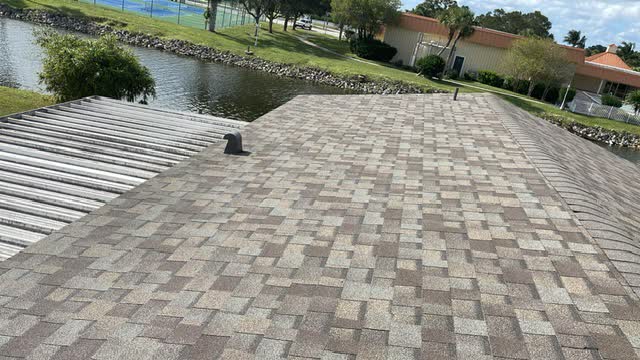
What Is Florida's 25% Roof Rule?
The phrase "25% rule" refers to a long-standing requirement in the Florida Building Code's reroofing provisions. In plain terms: if 25 percent or more of a roof section is repaired, replaced, or recovered, the work on that section can no longer be done to the older code the roof was originally built under, it has to meet the Florida Building Code currently in effect.
The rule exists for a clear reason. After Hurricane Andrew and the storm seasons that followed, Florida steadily tightened how roofs are attached, sealed, and protected against wind-driven water. The 25 percent threshold is the point at which the state decided a roofing project is substantial enough that it should bring that section up to modern standards rather than perpetuate an outdated assembly.
It is worth being precise about what the rule does and does not say. It is a code-compliance trigger for the work being performed, not a blanket order to tear off and replace a healthy roof. A small, isolated repair well under the threshold is generally done to match the existing roof. The rule only changes the picture once the scope crosses 25 percent of a roof section.
The current code is published and maintained through the Florida Building Commission; you can browse it at the official Florida Building Code portal. For how the threshold plays into a real repair-or-replace decision, see our guide on roof repair vs. replacement in Florida.
Did Florida Change or Repeal the 25% Rule?
In 2022 the Florida Legislature passed Senate Bill 4-D, which added subsection (5) to Section 553.844, Florida Statutes. This is the most important development for homeowners, because it carved out a meaningful exception to the older, all-or-nothing version of the rule.
The statute provides that if an existing roofing system or roof section "was built, repaired, or replaced in compliance with the requirements of the 2007 Florida Building Code, or any subsequent editions," and 25 percent or more of it is repaired, replaced, or recovered, then "only the repaired, replaced, or recovered portion is required to be constructed in accordance with the Florida Building Code in effect."
Read carefully, the exception is narrower than it first appears. It does not exempt the repair from current code, the part you are actually working on still has to meet today's standard. What it spares is the untouched remainder of a qualifying roof. A homeowner whose roof was built to the 2007 code or later is no longer pulled into reworking sections that were never damaged.
The dividing line, then, is your roof's code vintage. Roofs built or last replaced under the 2007 Florida Building Code or any later edition get the carve-out. Older roofs do not.
How Do I Know if My Roof Qualifies for the Exception?
Because everything turns on whether your roof was built to the 2007 code or later, the practical first step is figuring out when your current roof was installed and which code edition it was permitted under.
The most reliable record is the building permit. Roofing work in Florida is permitted and inspected by the local building department, and those records show the date and the code edition in force at the time. If you bought the home with the existing roof already in place, the permit history is usually available from the county or municipal building department, and a closing file or seller disclosure may reference it as well.
If the paperwork is unclear, a licensed contractor can help. During a roof inspection, a roofer can assess the assembly, look for signs of a post-2007 installation, and cross-reference permit records to determine which side of the line your roof falls on, before you authorize any work. Dalton Roofing provides this as part of a free roof inspection across St. Lucie, Martin, Indian River, and Palm Beach counties.
What Does "Up to Current Code" Involve?
When a roofing project does have to meet the current Florida Building Code, that can mean more than swapping shingles for like-for-like material. Florida's post-2007 roofing standards emphasize wind and water resistance, and bringing a roof section up to code can pull in measures the original roof never had.
Depending on the roof type, age, and location, those measures can include a sealed roof deck or secondary water barrier beneath the covering, stronger fastening of the roof deck to the framing, and updated underlayment and flashing details. The specifics vary by assembly and are determined by the local building official and your contractor, not by a single number on a page.
The takeaway for budgeting is straightforward: a project that triggers current-code compliance may carry costs a simple patch would not. That is not a reason to avoid the work, these upgrades are part of what makes a Florida roof more storm-resistant, but it is a reason to understand the scope before signing. A clear written estimate from a licensed roofing contractor should spell out what code compliance adds.
Why Does the Rule Matter for Repair-vs-Replacement Decisions?
The 25% rule is one of the quietest drivers of roofing cost in Florida, and it often tips a borderline repair toward a full replacement, especially on older roofs.
Consider a pre-2007 roof with damage spread across more than a quarter of a slope. Because the roof does not qualify for the Section 553.844(5) exception, that large repair can require bringing broader portions up to current code. Once the added compliance work is priced in, the total can land close enough to a full replacement that replacing the roof outright, and resetting its service life, warranty, and insurability, becomes the better value.
On a roof built to the 2007 code or later, the math is gentler: the exception confines the upgrade to the portion you are repairing, so a large repair stays a repair. This is exactly why knowing your roof's code vintage before authorizing work is so valuable. If replacement turns out to be the smarter call, ask about roof financing options to spread the investment over time.
How Does the 25% Rule Apply by Roof Code Vintage?
The same repair can play out very differently depending on when your roof was built. This comparison summarizes how the rule and the Section 553.844(5) exception treat each case.
| Situation | Roof built to 2007 FBC or later | Roof predating the 2007 FBC |
|---|---|---|
| Qualifies for the 553.844(5) exception? | Yes — the carve-out applies | No — the carve-out does not apply |
| Less than 25% of a section repaired | Work matches the existing roof; current-code details apply to the repair itself | Same — the work generally matches the existing roof |
| 25% or more repaired, replaced, or recovered | Only the worked-on portion must meet current code | The work can require bringing broader portions up to current code |
| Typical effect on a large repair's cost | Contained to the area being repaired | Can rise toward the cost of a fuller replacement |
| Documentation that helps | Permit showing a 2007-or-later installation | Older or missing permit; an inspection helps establish the roof's vintage |
| Bottom line | Large repairs generally stay repairs | Large repairs can trigger broader code upgrades |
This article is general information, not legal advice. Code application depends on your specific roof, county, and the local building official's determination, confirm details with a licensed contractor and your building department.
Whether the 25% rule helps you or costs you comes down to when your roof was built. Dalton Roofing offers free roof inspections across St. Lucie, Martin, Indian River, and Palm Beach counties, we'll check your roof's condition and code vintage and give you a written report. For roof damage that needs attention now, call (561) 662-6622 or visit storm & emergency roof repair any time, 24/7.