
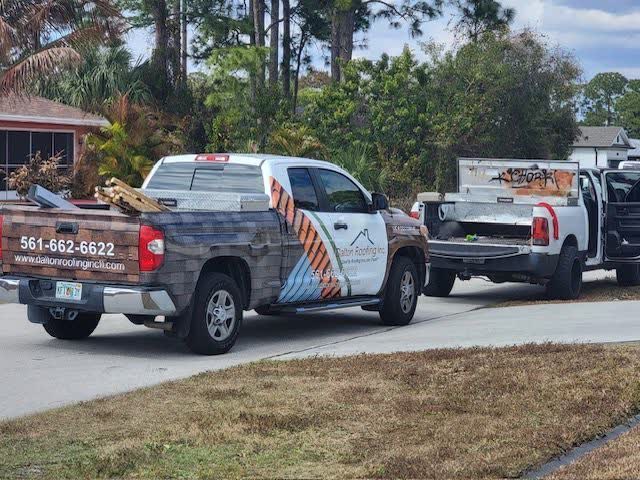
If the season has already started, a professional inspection is still worthwhile — finding lifted flashing or a cracked pipe boot now is better than discovering the damage during a named storm.
What Does Dalton Roofing Inspect Before Storm Season?
A pre-season visit is a systematic pass over every part of the roof that fails first in wind and rain, not a walk around the yard.
- Shingles and tiles — granule loss, curling, cracking, missing sections
- Flashing — chimney bases, pipe boots, skylight curbs, drip edge, sidewall transitions
- Roof deck — probed for soft spots from attic access; soft decking signals rot or delamination
- Penetrations — pipe boot collars, HVAC curb seals, vent caps, satellite dish mounts
- Roof-to-wall connections — hurricane clips or straps, required by Florida Building Code in the Wind-Borne Debris Region
- Gutters and fascia — drainage clearance and hanger security
- Written report — dated photos and findings you keep for insurance purposes
Why Schedule Before Storm Season Instead of After a Storm Watch?
Booking in spring or early summer, before the season peaks, gives Port St. Lucie homeowners three concrete advantages.
Contractor availability. Once the National Hurricane Center issues a watch for the Treasure Coast, every reputable licensed roofer in St. Lucie, Martin, and Indian River counties has a full schedule within hours. Homeowners who call after a watch is posted face days-long waits for non-emergency work.
Catch winter and spring damage early. Florida's off-season months bring temperature swings, wind events, and heavy rain that loosen shingles, deteriorate caulk around flashings, and crack rubber pipe boot collars — often without triggering an interior leak immediately. A spring inspection surfaces these before the first tropical system makes them worse.
Insurance documentation. Florida homeowners insurance carriers frequently challenge hurricane roof claims by arguing that damage was pre-existing rather than storm-caused. A written inspection report dated before the season, paired with contractor-documented photos, is the strongest counter to that argument at claims time. See our storm emergency repair page for what to expect when filing a claim.
What Do You Miss from the Ground That a Professional Catches?
A homeowner walking the yard perimeter can spot obvious blow-offs or large missing sections of shingles. But several of the highest-risk conditions are not visible from the ground:
- Flashing seal integrity requires close examination of every caulked joint and metal edge — not assessable at 20 feet below.
- Soft decking is identifiable only from attic access or by walking the roof surface.
- Back-nailed shingles look identical to properly fastened ones from ground level but will lift under sustained wind loads.
- Hurricane clip installation cannot be verified without attic access.
A licensed contractor's written report also carries weight with your insurer that a homeowner's own phone photos typically do not. Most licensed inspections take 30–60 minutes and are available at no cost from Dalton Roofing.
Pre-Season vs. After-Storm: What Each Inspection Targets
Florida roofing professionals generally recommend two inspections per year: one before hurricane season and one after it ends.
| Area | Before the Season (Spring & Early Summer) | After a Storm |
|---|---|---|
| Shingles & tiles | Granule loss, curling, cracking, back-nailed tabs | Blow-offs, displaced pieces, exposed decking |
| Flashing | Deteriorated caulk, lifted metal edges | Lifted or missing sections; interior ceiling staining |
| Roof deck & attic | Soft spots from attic access, moisture staining | Sagging, visible daylight, wet insulation |
| Penetrations | Cracked boot collars, degraded sealants, loose equipment | Shifted equipment, open gaps at penetration points |
| Gutters & drainage | Clear debris, re-anchor hangers, check seam corrosion | Storm debris, detached sections, downspout separation |
| Roof-to-wall connections | Confirm clips or straps type and presence | Check for racking or separation at connection points |
What Happens During Dalton's Free Pre-Season Inspection?
Dalton Roofing offers free pre-season roof inspections across Port St. Lucie, Stuart, Palm City, Jensen Beach, and surrounding Treasure Coast communities.
- Scheduling. Call (561) 662-6622 or submit a request through our inspection page. We confirm an appointment window at no cost.
- On-site inspection. A licensed crew member walks every roof slope, probes the deck for soft spots through attic access where available, and checks every flashing penetration and the gutter system.
- Written report. You receive a written findings summary with dated photos — the format insurers and adjusters recognize, yours to keep regardless of next steps.
- No-obligation estimate. If repairs are needed, we provide a written estimate. If the roof is in good shape, we tell you that.
Dalton Roofing holds Florida State Certified Roofing Contractor license #CCC1330147, issued by the Florida Department of Business & Professional Regulation, and has served Port St. Lucie and the Treasure Coast since 2004.